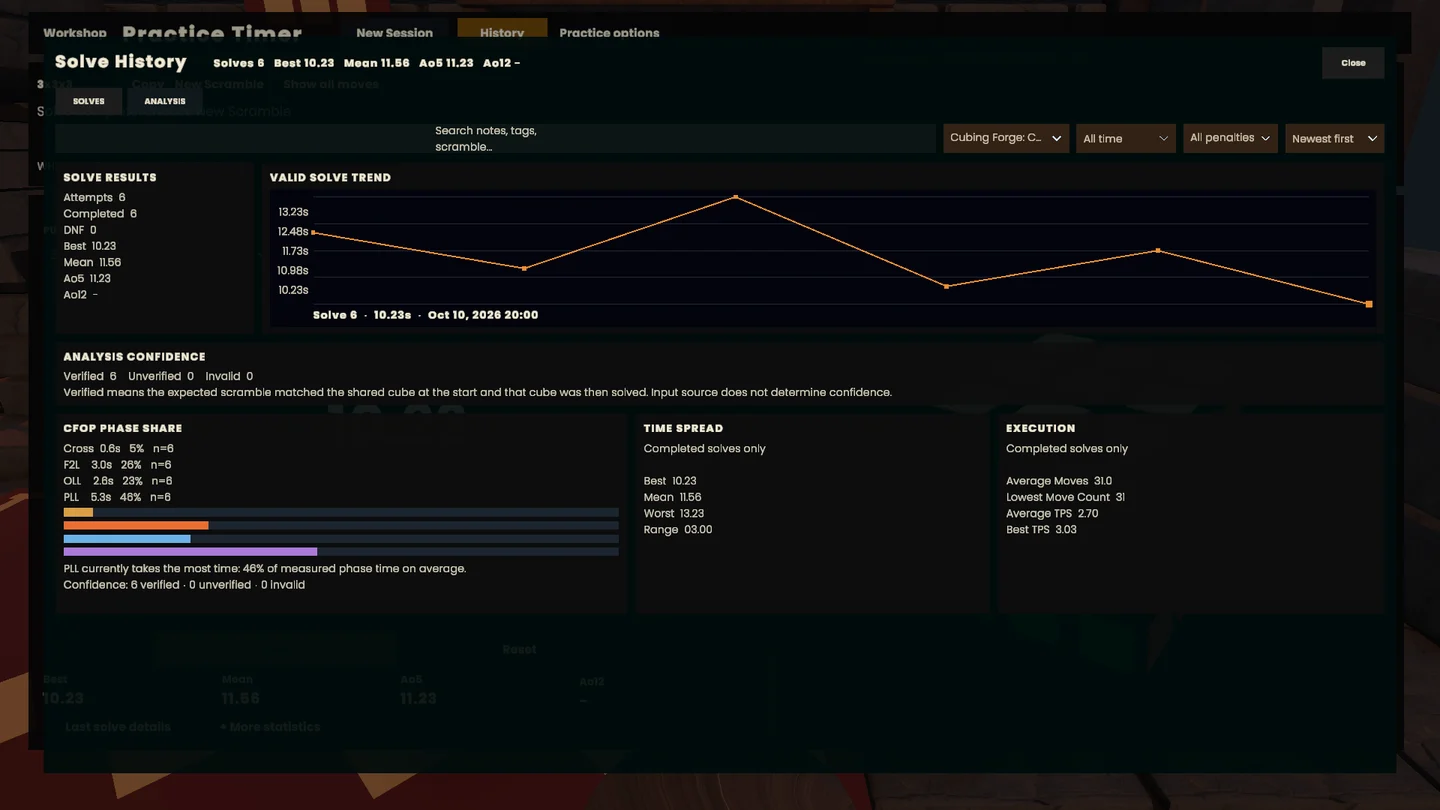
Inside Cubing ForgeThe in-game 3×3 CFOP Library, recognition tips, prepared examples and case practice. Verified 3×3 CFOP solves can also reveal time spent in each phase.
What does CFOP mean?
CFOP stands for Cross, First Two Layers, Orientation of the Last Layer and Permutation of the Last Layer. These stages describe different jobs within a 3×3 solve.
| Stage | The idea |
|---|---|
| Cross | Establish the first four edges around a centre. |
| F2L | Complete the first two layers with corner-and-edge pairs. |
| OLL | Orient the last layer so the top face is one colour. |
| PLL | Place the last-layer pieces in their correct positions. |
Understand the case behind an algorithm
Remembering moves is only part of learning a case. Recognising its pattern and knowing the starting grip are part of the same task.
Cubing Forge’s Library combines recognition tips, notation and prepared examples. You can step through the sequence and try it on an interactive practice cube inside the game. Learned-case tracking helps you keep track of the material you have visited.
Return to what you want to remember
The game gives CFOP a dedicated place in its 3×3 learning content. It also offers Daily Trials that revisit learned 3×3 algorithms, bringing previously encountered cases back into practice.
For players who are still working towards a first solve, the separate 3×3 Campaign provides a guided starting path. You can explore more advanced Library content as your understanding grows.
Look beyond a single finishing time
For supported, verified 3×3 CFOP solves, Cubing Forge can break the result into Cross, F2L, OLL and PLL phases. That makes it possible to see which part of a solve took the time.
Session history and available solve statistics give context to the result. Phase analysis depends on a supported, verified solve; it is not a promise that every puzzle or solving method receives CFOP splits.
Put it into practice
Continue in Cubing Forge.
The CFOP algorithm Library, interactive examples, case practice and solve-analysis tools are part of Cubing Forge. See the game on Steam to bring them into your own workshop.