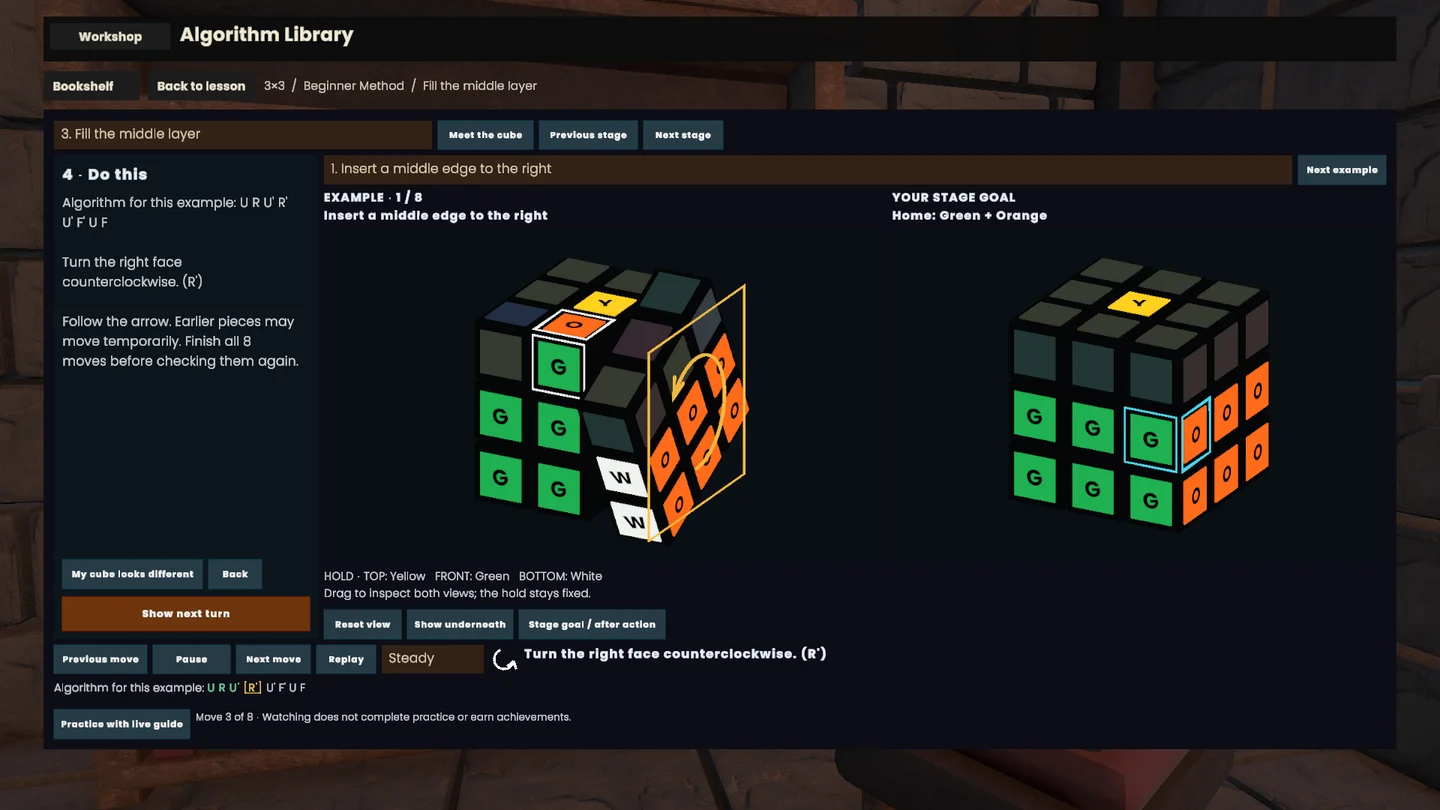
Inside Cubing ForgeThe 3×3 Campaign introduces pieces and notation. The in-game Library provides prepared examples with step-by-step playback and an interactive practice cube.
Why notation matters
Cubing lessons use a shared shorthand for face turns, directions and rotations. It makes a move sequence compact enough to recognise, compare and return to later.
For a new player, the difficult part is often connecting a written symbol to what happens on the puzzle. The face being turned, the viewing angle and the current grip all affect how easy that move is to understand.
See the move inside the game
Cubing Forge’s Library places lesson instructions alongside examples you can inspect. Step-by-step playback lets you pause a sequence and look at what changed before moving on.
An interactive practice cube gives you somewhere to try the idea. You can return to the example when a move is unclear, rather than relying on a static string of letters alone.
A starting point for new 3×3 players
The guided 3×3 Campaign starts with the foundations, including pieces and notation, before building towards a complete solve. Progress involves real cube-state objectives, so the journey connects the explanation to something you do.
This guided Campaign is specific to 3×3. The other supported puzzles have their own Library content, virtual play and solve timing.
A foundation for the next technique
Recognising notation becomes useful again when you explore a different method or revisit a case. Cubing Forge combines notation, recognition tips and playable examples in its learning experience.
You can play with a virtual puzzle using your PC. A physical cube is not required; compatible Bluetooth 3×3 smart cubes are also supported for selected activities.
Put it into practice
Continue in Cubing Forge.
The interactive lessons and playback shown here are features of the Cubing Forge game. Explore the full workshop on Steam for Windows and Linux.